
Playing The Game—For Real This Time
games from the playful tarot workshop & a reflection on the last six months

Hello and welcome back to structural tarot! As always, you can check out the previous posts here!
You guys! It’s the six-month anniversary of this blog!! Also the 22nd post in the structural tarot series—so you could say this is kind of my The World moment. I set out, late last May, with a specific goal: to write one post a week explaining my system of tarot mnemonics and games. Now I feel like I’ve (mostly) completed that mission. My posts from now to the end of the year will cover the less-explored sides of tarot practice—nonspreads, conversations, games, and magic. This is also where I start shilling the book(!) I’ll be releasing in spring of 2026, which will be in a workbook format. I’ll cover all the information in this series and more using practical exercises.
What else is coming next year? Expect some tarot, some art (history), some personal posting, and lots of esoterica. I’ll be starting with a series on biblically accurate angels and my lived experience encountering them (and possibly angelic ritual magic, if there’s interest?). So stick around if you like wheels within wheels and/or red-string diagrams.
But, first! Let’s get loose, learn some games, and free tarot from its context (finally)!
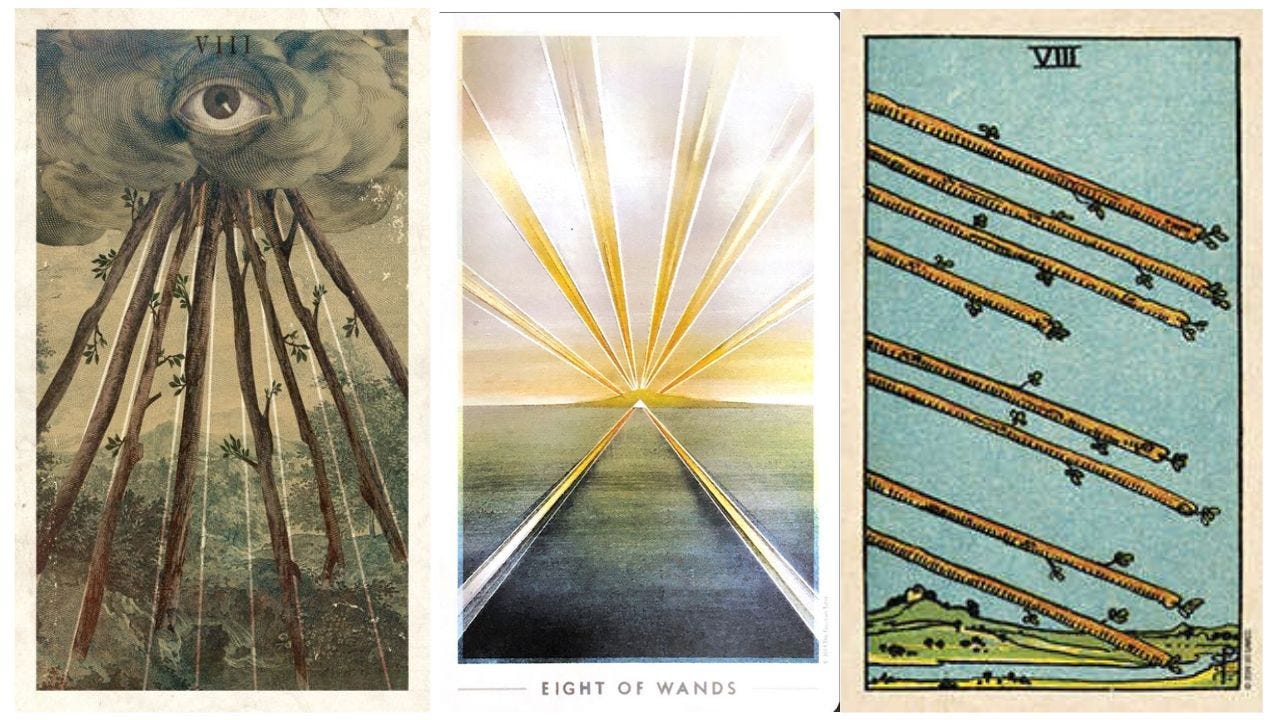
Playing The Game, For Real This Time
In my Playful Tarot workshops, I try to introduce games that take the magic out of tarot. Or, I should say, I try to play games that take the 🧙♂️🔮MAGICK™™™🔮🧙♂️ out of tarot. I’ve found that letting go of what tarot should be and what the cards should mean is the only way that any real magic can happen. So, grab a tarot deck and play along.
Throughout this series, I’ve reiterated the importance of context and structure in understanding tarot. Now, it’s time to throw all of that out the window. Don’t think of it as a scrying tool. Don’t think of it as a rich cultural text with 300+ years of history. Instead, play with the cards like dolls.
First Game—Dolls
Go through your tarot deck and find two people (or animals) in a relationship with each other. It doesn’t need to be a romantic relationship, and it certainly doesn’t need to be a healthy one. Make up characters and describe the history between them—extra points for originality! Are they coworkers? Exes? Messy exes? Messy exes forced to become coworkers? Get as detailed as you like.
If you’ve read the rest of this series, you probably have your own ideas about what these cards mean, influenced by what you’ve read (here or elsewhere) and what’s come up in readings. The story you make up may or may not involve those pre-existing archetypal or personal understandings, and either is fine. What’s important is that you make up a story that feels real to you. However you get there is valid.
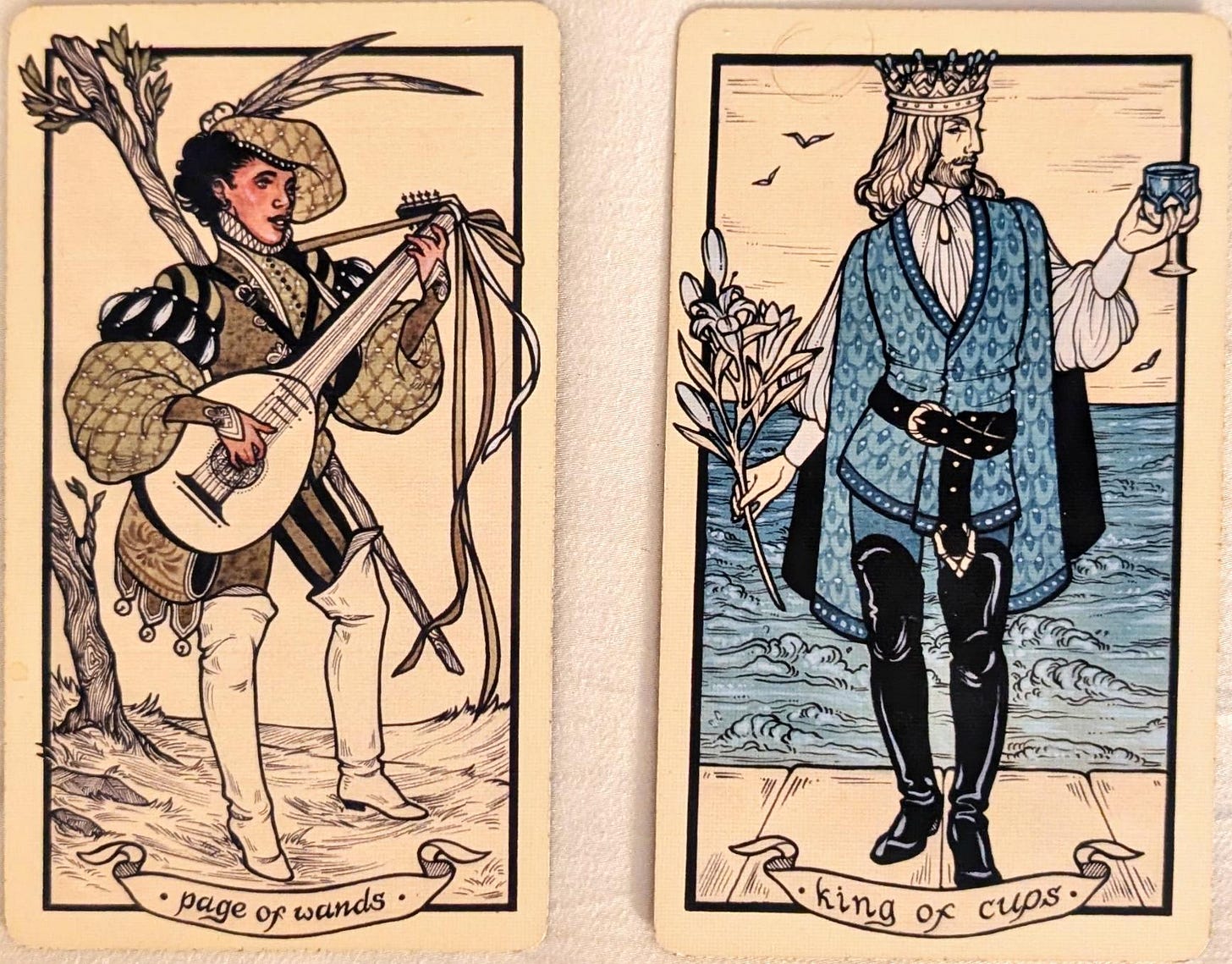
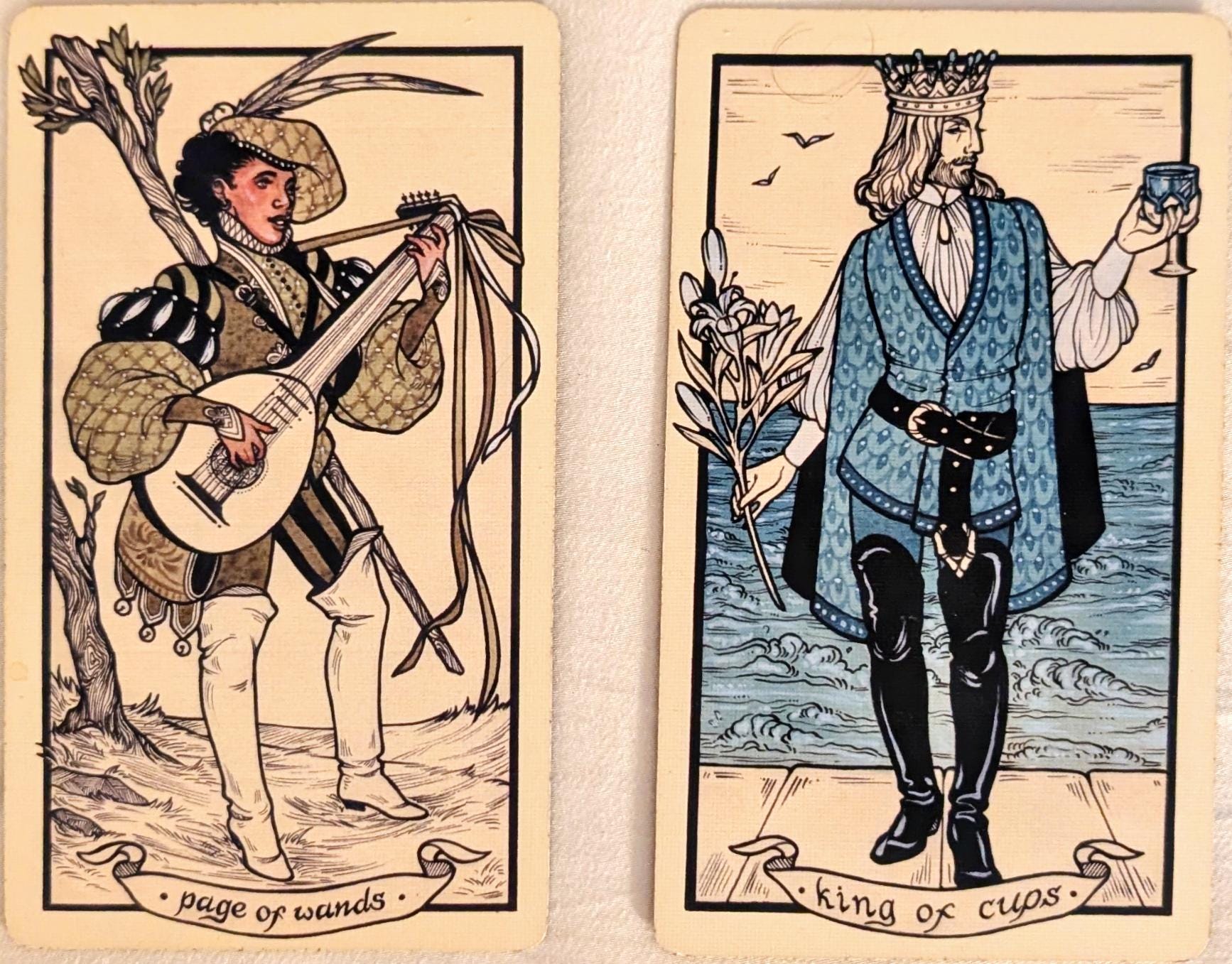
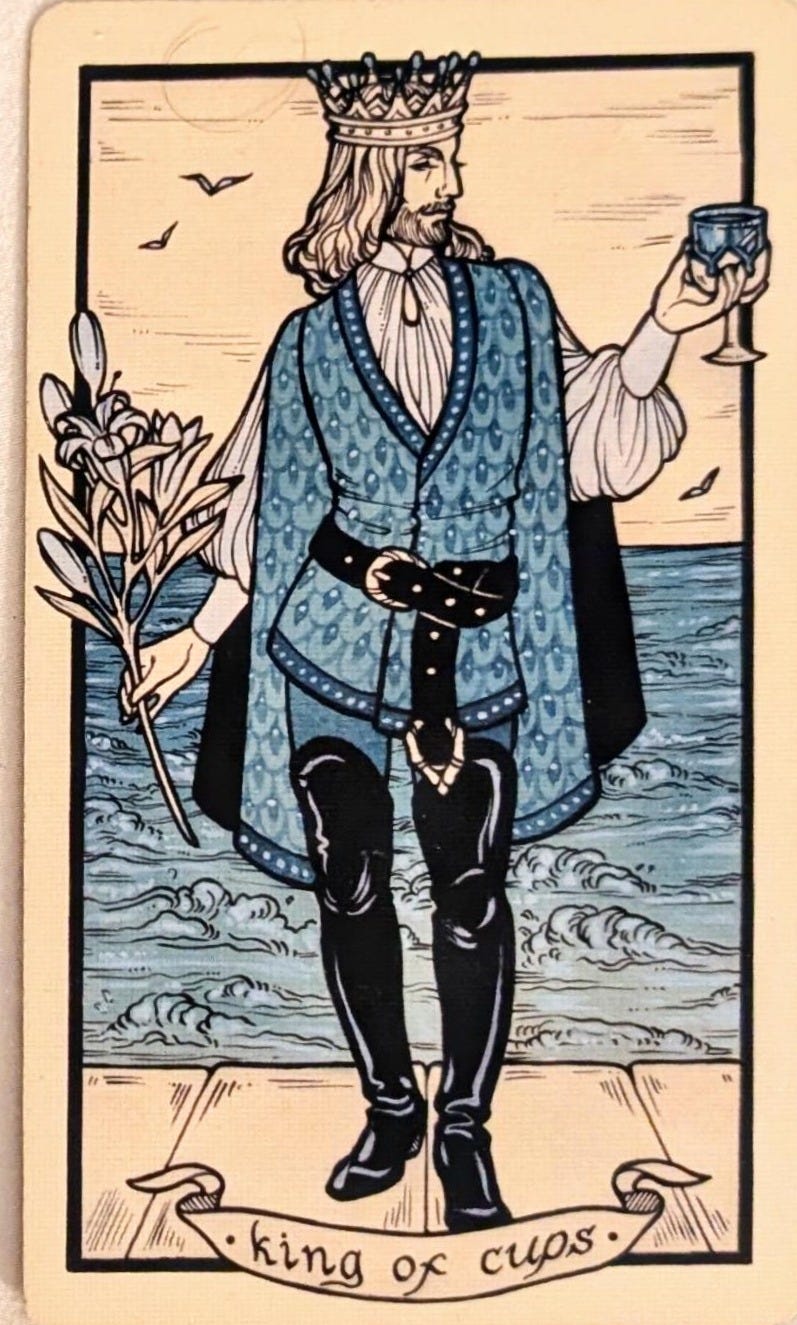
They got divorced in 2020, but not for lack of love. Their relationship just couldn’t handle the pressures of quarantine, and their respect for each other crumbled in close quarters. Now she’s back from studying traditional lute playing in Spain, and he’s throwing her a welcome home party. Their friendship is strong, although the wounds are still tender. For her, a rekindled romance is out of the question. For him? Well. . . After you’ve spent time fleshing out the relationship between your characters, focus on one of them. Imagine a conversation between the two of you, and think of a problem they might have or a question they might ask you. It might be about the relationship, but if you think of something else, go with it!
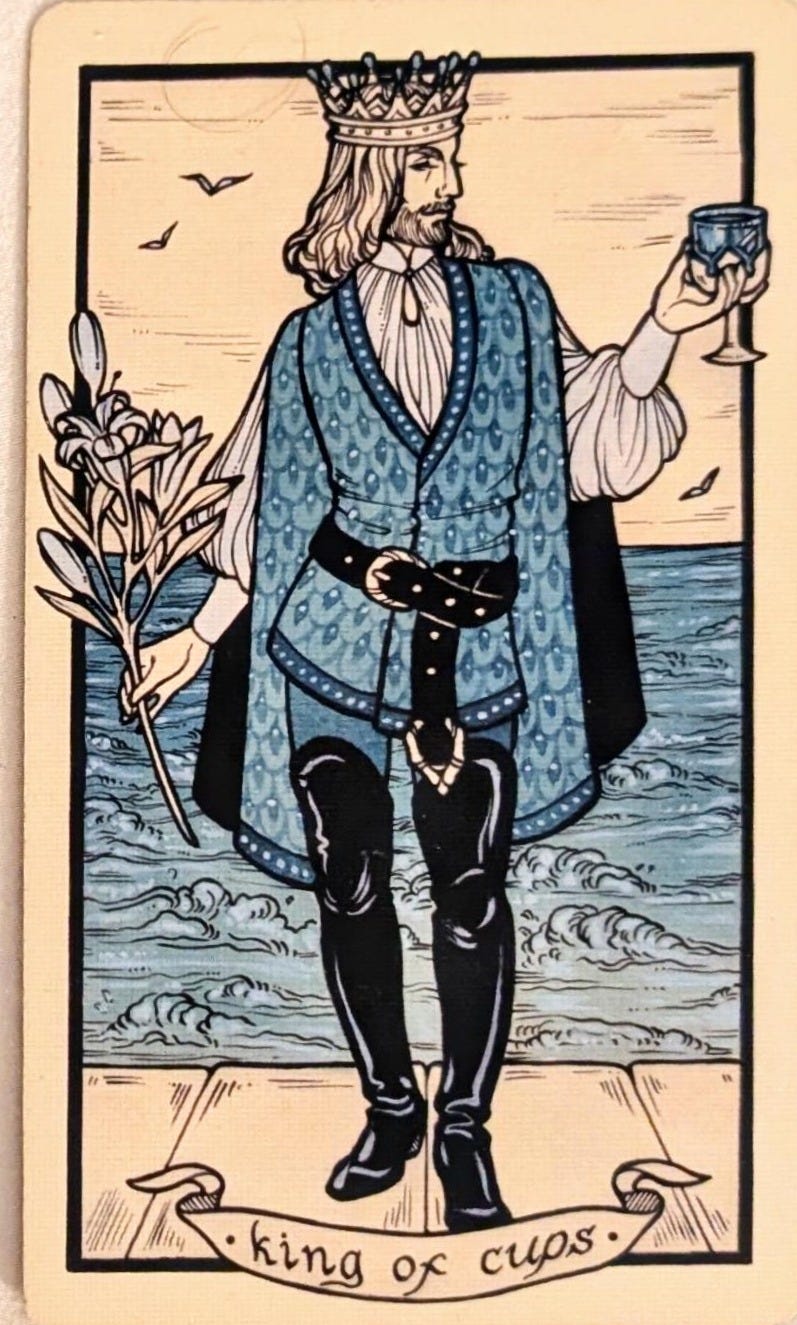
He thought he’d gotten over the divorce, but seeing her again complicated things. He understands why a romance is a bad idea—they didn’t work as a couple, plus she’s going on tour with her new lute band—but he can’t deny that the feelings are still there. Seeing her happy and inspired by her music brings back everything he first loved about her. What should he do? Then, do a tarot reading for your character. This can be as simple as a one-card draw or as complicated as a celtic cross—it’s up to you! I’ll be using the Midwit Spread, from out post on meme-based tarot spreads.
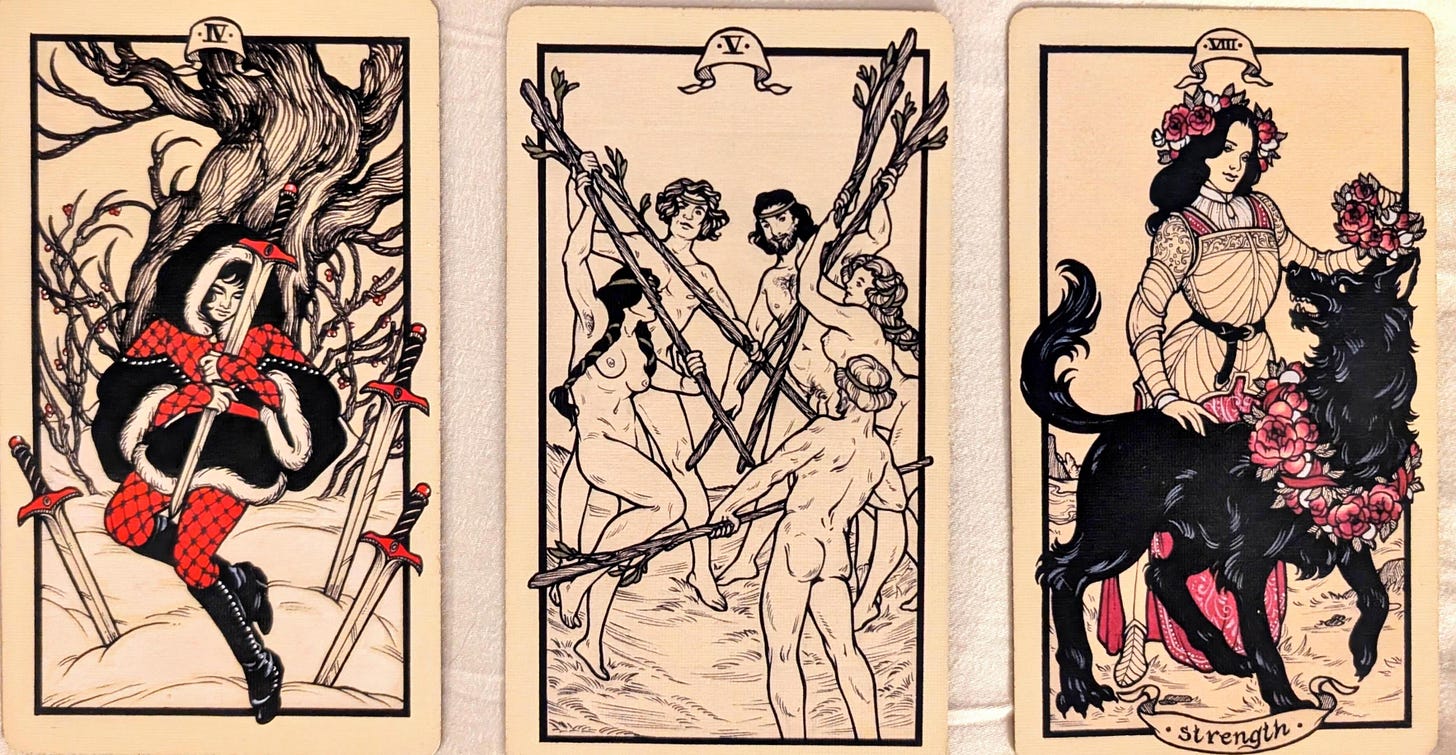
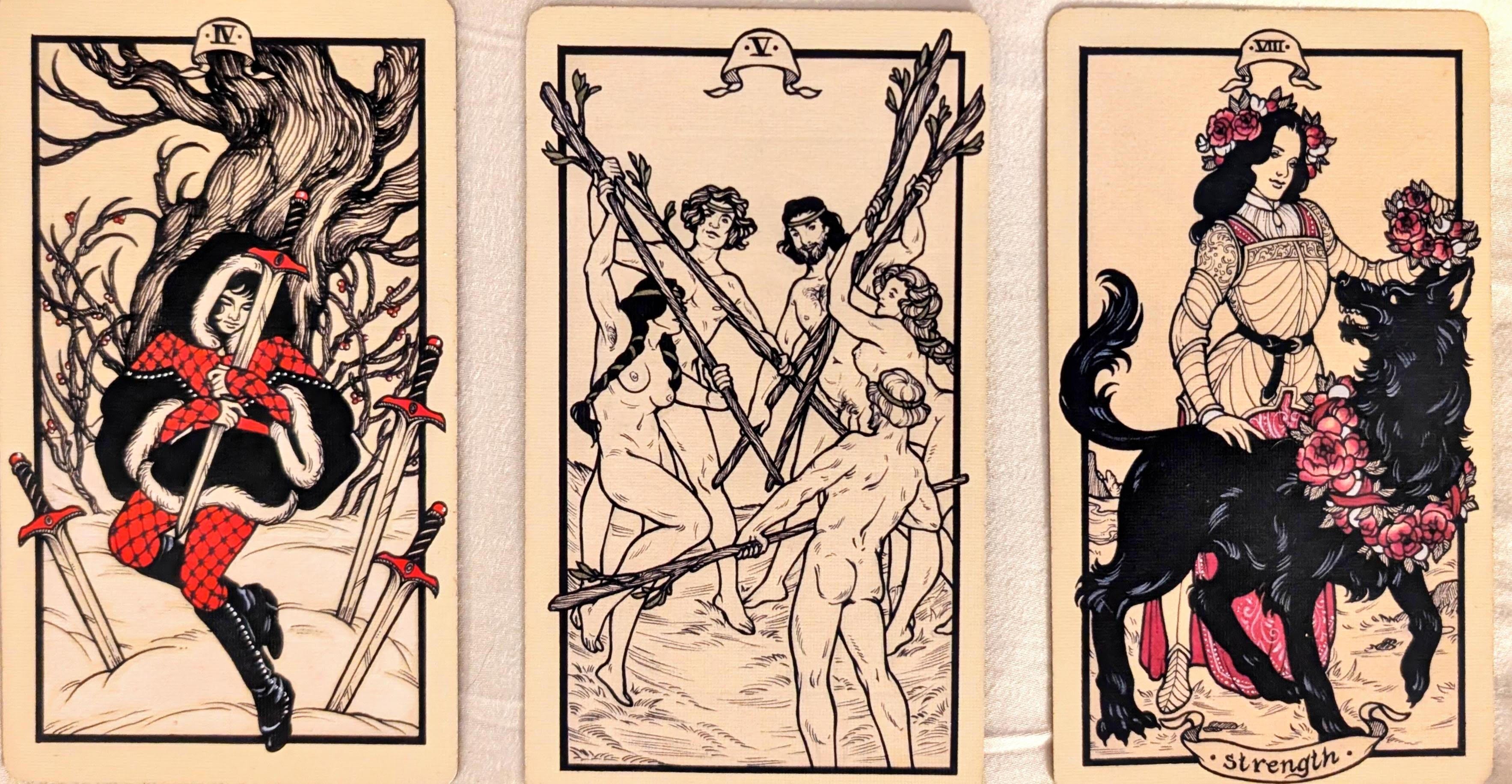
dimwit (4 of Swords), midwit (5 of Wands), and highwit (Strength) On the far left we have the dimwit card—the naïve or foolish advice for the question. With the Four of Swords, we see an immediate urge to withdraw. Rather than acting on his feelings, our querent should repress his emotions and set the problem aside until the party is over. Preemptively rejecting himself will surely cause the fewest hurt feelings, right? It’s not like the person who knows him better than anyone would pick up on his discomfort? Right…?

Next is the Midwit—the action our querent might choose if he considered the topic with more knowledge and intelligence—but perhaps lacking in wisdom. The Five of Wands here urges our querent to fight for his love! Sure, she’s clearly moved on. And, yes, her new career will keep her too busy to spend time and energy rehashing old wounds. But who cares! LOVE!!
Finally, we have the highwit—the advice that superficially agrees with the dimwit, but is based on holistic wisdom. As with the Four of Swords, Strength urges out querent to not immediately declare his romantic feelings. But, rather than the dimwit move of repressing his emotions, the highwit position comes from a place of loving acceptance. It takes real strength to love someone who can’t be what you want them to be. Is he willing to take her as she is, and accept her friendship as it’s offered? Is he willing to cheer for her when her choices take her away from him? Maybe, or maybe not. And, certainly, they’ll have to talk more about it later. But, for now, the music is bumping and it’s good to see her again. Our querent decides to act with Strength—acknowledging the bittersweetness of this reunion, while celebrating the successes of his (brilliant, beautiful) ex-wife anyway.

Second Game—Positional Reading
Say “thank you,” to the cards, then shuffle them back together and take a moment to clear your mind. The next game is about you.
For this one, sit with yourself and allow a curiosity to come up. What’s an aspect of yourself you don’t quite understand, but would like to know better? What’s something you (don’t) like about yourself that you’d like to examine further? Some of you won’t have to think for very long, especially if you do regular shadow work. Others will have to think for longer, and that’s ok!
When you feel ready, choose a signifier. This is a card that resonates with you and reflects the part you’re curious about. Feel free to look through the deck and choose based on ~vibes,~ or go for a card you already know and like. If that’s too vague, here are some major arcana connections to think about:
Fool—your inner dumbass
Magician—your inner showoff
High Priestess—your sense of (in)justice
Empress—your softness
Emperor—your anger
Hierophant—your inner critic
Lovers—your inner romantic
Chariot—your inner performer
Strength—your inner child
Hermit—who you are when nobody’s looking
Wheel—who you are at your best/who you are at your worst (you decide)
After you’ve picked a card, look at it for a bit while focusing on that curiosity. Then, put it back in the deck and give the whole thing a good shuffle. You’ll want to shuffle it at least 8 times, or just put the cards face-down on the floor and swirl them around to really mix it up.
Next, go through the deck and find your card. Pull it out, along with the cards before and after it, and lay them out with the signifier card in the middle. The card before represents a message from that part of you, and the card after is a piece of advice they want to give you.
For example, I became curious about the most hopeful part of me, and chose The Star as a signifier. The card was positioned near the bottom of the deck. Under it was Strength, and on top was the Two of Coins.
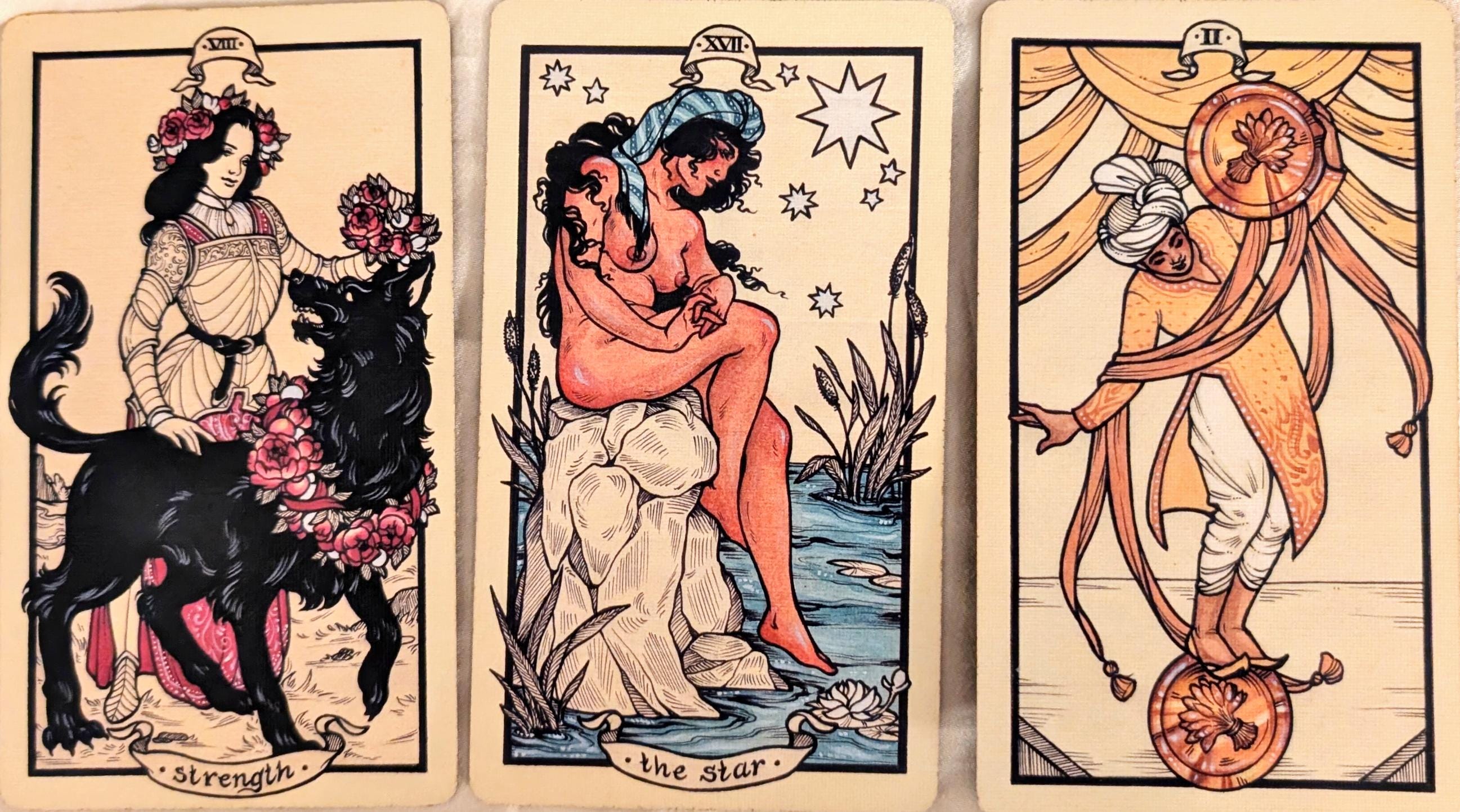
First, the message—Strength. In interpreting this, I’d like to quote my own article on this card:
“Strength is showing gentle resolve even in the face of violence. . .To meet grief with love, to face terrors with gentleness, is one of the greatest achievements humans are capable of. Despite this, it is rarely recorded. . .[T]he quiet achievement of loving in the face of pain is available to everyone equally, at all times. There is always enough grace to go around, for any with the courage to reach for it through pain.
It makes sense that this message would come from the most hopeful part of me. For me, hope has always been the foundation of my strength, and my continued hope is built upon a lifetime of effort to stay gentle in hard times. The two are inextricably linked, and this reading is here to remind me of that.
Then, the advice. I cover the Two of Coins in this article, if you’d like to reference it. In brief, the traditional meaning is overwhelm and uncertainty—keeping a lot of balls in the air. However, that’s not the interpretation that comes to me when looking at this card in this context. Instead, I see the man balanced on his ball and wrapped in ribbons as a sign to practice balance and wrap myself in ropes physically, rather than metaphorically. In other words, I hear my inner hope saying “Hey, you haven’t been to the rock gym in a while. Go get some exercise.”
Final Game (for now)—Fish For Compliments
Ok, this one isn’t so much a game as an underutilized tool. But I do it at the end of the Playful Tarot workshops, so I think it belongs here. Here’s how the game goes:
Ask for a compliment while you shuffle the deck.
Draw a card. There’s your compliment.
My point with this exercise is twofold. First, I think it’s important to practice silly, low-stakes tarot as often as possible. Don’t wait until something Important™ comes up. If you only practice tarot when you’re stressed, you’ll feel stressed whenever you use it! Ask your tarot deck casual questions, do readings based on memes, and generally be as playful as possible. Then when the Important™ stuff comes up, your tarot deck will help you feel relaxed and open to solutions.
My second point here is to talk about what makes a “good” question. This is different than a “meaningful” question. You can (and should) ask your tarot deck questions that are deeply meaningful to you, but you can also ask a “good” question about abstract nonsense. What makes a question (in)effective is the same, whether want to delve into the most profound mysteries of existence or just chat about some bullshit.
What defines a good tarot question? It should be:
open-ended (not a yes or no question)
specific enough to suggest an answer
general enough to surprise you
Keep in mind that tarot doesn’t tell the future. Divination works when you interpret the symbols, to reveal things you know deep down but may not have realized consciously. So set up for success by giving yourself something to work with!
Examples of bad (aka ineffective) ways to ask for a compliment:
Am I smart? (closed question—only answers are “yes” or “no”)
Give me a compliment (too general)
Compliment my work ethic (too specific)
What are my greatest strengths? (better, but still too general)
How have I improved? (better, still too general)
Here are some better options:
Where does my intelligence shine?
What’s a quality that other people appreciate about me?
What am I like when I’m at my best? How can I show up as my best self more often?
What’s one strength of mine that I don’t recognize?
How have I improved as a person since starting ____?
Finally, if you’re not used to complimenting yourself and feel totally at a loss. “What’s one thing I can be proud of?” always works.